The most expensive thing about a reconciliation break isn't the break itself. It's the half-hour your most senior ops analyst spends understanding what happened, when the answer is almost always the same as the last twelve times this pattern showed up.
This post walks through a real IBOR/ABOR break we saw last month, the agent's reasoning trace, and how it resolved in under two minutes. Names and identifiers have been changed; everything else is as it happened.
The setup
Mid-sized multi-strategy fund. Investment Book of Record (IBOR) is computed continuously through the trading day. Accounting Book of Record (ABOR) is struck overnight by the fund administrator. They should reconcile to within a tolerance band of 0.5 basis points on NAV.
On the morning in question, the delta on Fund VI came in at 4.2 bps. Three to four hundred basis points over tolerance. Big enough that the ops team wouldn't sign off until it was understood.
The break
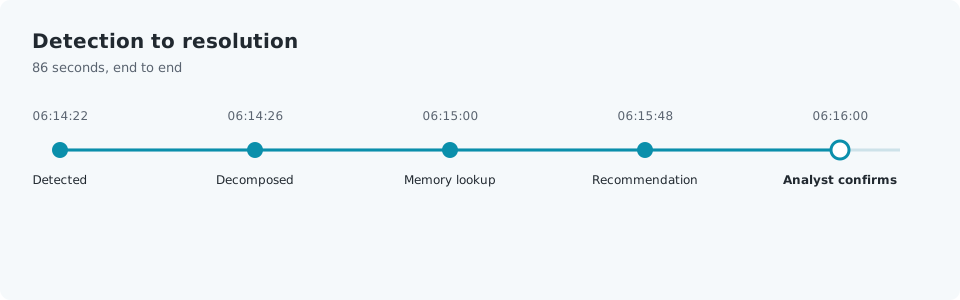
At 06:14:22 UTC, MatchStrat surfaced the exception:
{
  "break_id":   "brk_2026_05_14_VI_0142",
  "type":       "ibor_abor_nav_delta",
  "fund":       "Fund VI",
  "ibor_nav":   1_482_910_443.18,
  "abor_nav":   1_482_287_904.62,
  "delta_bps":  4.20,
  "tolerance":  0.50,
  "first_seen": "2026-05-14T06:14:22Z"
}
The break itself is just a number. Useful as a tripwire, useless for resolution. The interesting work happens next.
The agent's first pass
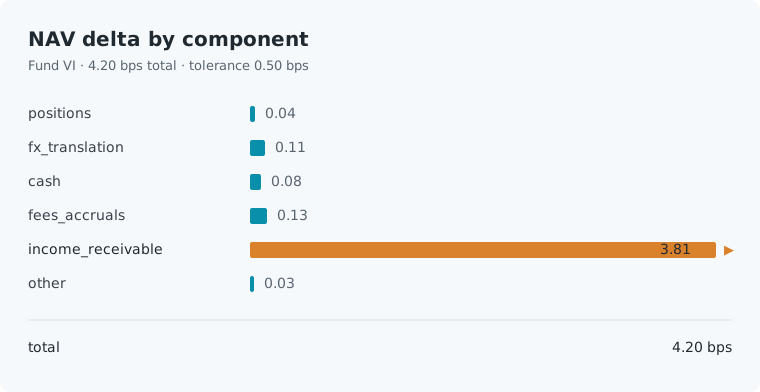
Within four seconds, the agent had decomposed the NAV delta into its constituent layers. It looks something like a waterfall:
positions       : 0.04 bps
fx_translation  : 0.11 bps
cash            : 0.08 bps
fees_accruals   : 0.13 bps
income_receivable: 3.81 bps   ← flagged
other           : 0.03 bps
─────────────────────────
total           : 4.20 bps
One component, income receivable, accounts for nearly all of the variance. Useful. The agent has narrowed the search space from "anywhere in a $1.5bn book" to "approximately $620k of expected income that the two systems disagree about."
Memory lookup
The next step is the part generic reconciliation tools don't do. The agent queries the fund's institutional memory: have we seen breaks of this shape before?
"This shape" means: same fund, same break type, same dominant component, and a delta in the same order of magnitude. The query returned eleven candidates from the prior nine months. Of those, eight had been resolved with the same root cause: a corporate action announcement processed by the administrator with a different ex-date than the one the IBOR was using.
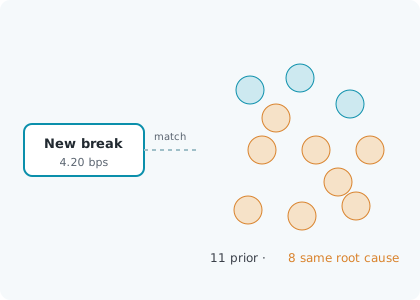
The memory isn't a static rulebook. It's a graph of breaks, root causes, evidence trails, and the human who closed each one, keyed by structural similarity, not by exact match.
The candidate root cause
The agent surfaced this hypothesis with confidence 0.84 and supporting evidence:
- Corporate action C/A-2026-2841 (special dividend) on holdings symbol XYZ Corp processed by IBOR on May 12, ex-date May 13
- Same action processed by administrator with ex-date May 14
- One-day timing mismatch on accrual of $623,118.42
- Difference matches 3.78 of the 3.81 bps in income receivable to four decimal places
Resolution
The agent's recommendation appeared at 06:15:48 UTC:
- Confirm the timing discrepancy on C/A-2026-2841 with the administrator
- Apply a one-day reclassification entry on the income accrual side
- Expect break to close on tomorrow's run when admin's accrual catches up
- Flag the corporate actions feed as needing a timing sync review
The on-call ops analyst, alerted via Slack at 06:16, confirmed the recommendation, accepted the reclassification, and routed the timing question to the admin liaison. Total elapsed time: 86 seconds from detection.
What this is and isn't
This isn't magic, and it isn't replacing humans. The analyst still made the call. The agent didn't "discover" anything new, every fact it used was already in the fund's own systems. What changed is the time-to-context: from 30 minutes of investigation to 90 seconds of confirmation.
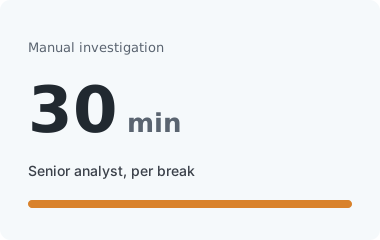
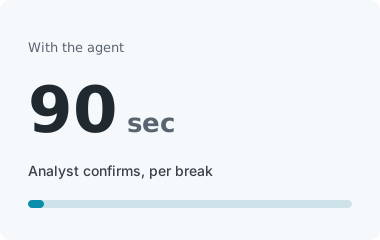
Multiply that by the 40–80 breaks the team sees in a typical week, and you start to see why we built this the way we did.
If you'd like to see this on your own data, book a demo. We'll schedule a 45-minute working session.